Free Inventory Management System: What Each Kind of Free Costs You
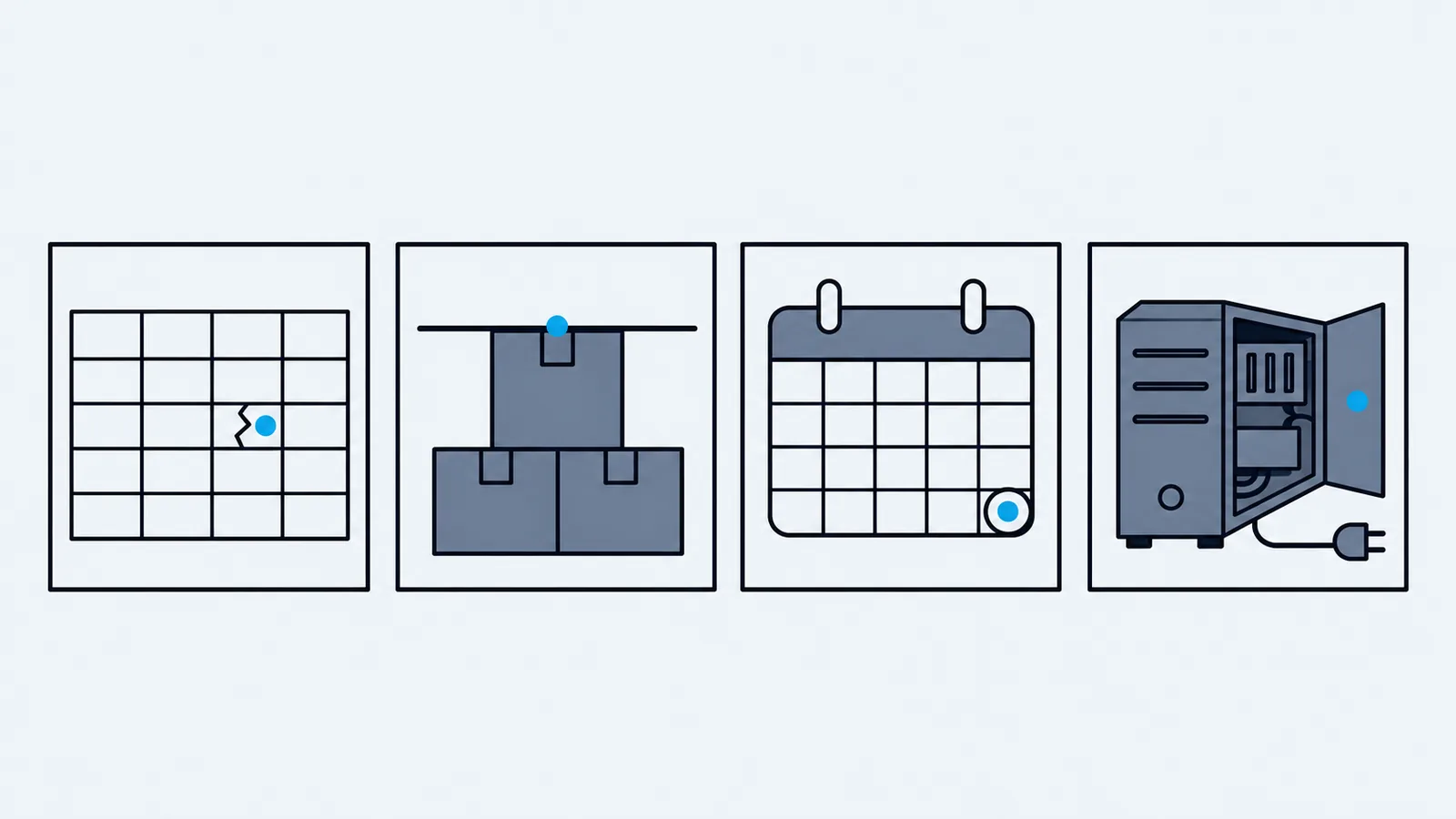
Sortly's free plan stops at 100 items and one user. A spreadsheet stops when two people edit the same tab. A free trial stops in two weeks. Self-hosted software doesn't stop, but you run the server. Every free inventory system has a point where it costs you something, and the useful question is which point you'd rather hit.
Four kinds of free
A spreadsheet. Fine for a few dozen products in one place. It breaks the day a formula goes wrong or two people overwrite each other. The trade-off is in spreadsheet vs inventory software.
A free plan from a hosted product. The vendor runs it and caps it. Sortly's free plan, for instance, allows 100 items, one user and one custom field. The cap is set low enough that growing means paying.
A free trial. Free for a while, then not. Good for evaluating, poor for running a business, and the shorter it is the harder the migration.
Open source you host. No item or user caps, because there's no vendor to set them. The cost moves to you: a server, and someone to keep it updated and backed up.
| Money | Time | Data | What breaks first | |
|---|---|---|---|---|
| Spreadsheet | None | Grows fast with size | You own it | Everything is manual |
| Hosted free plan | None until the cap | Low | Vendor holds it | Items, users, features |
| Free trial | Subscription afterwards | Low, then a migration | Vendor holds it | Time |
| Self-hosted open source | A server | Setup, updates, backups | You own it | Whatever you neglect |
A growing shop, three years
Take a shop that goes from 300 products and one user to 2,000 products and four users, with a second location along the way. Here is that against Sortly's published plans, billed monthly, and against running Inventoros yourself.
Hosted (Sortly, monthly billing, November 2026)
  Year 1   300 items, 1 user     Advanced  $49 x 12   =  $588
  Year 2   900 items, 3 users    Ultra    $149 x 12   = $1,788
  Year 3   2,000 items, 4 users  Ultra    $149 x 12   = $1,788
  Total                                               = $4,164

Self-hosted (assumptions: $12 server, 6 h setup, 2 h upkeep a month, $50 an hour)
  Year 1   server 144 + setup 300 + upkeep 1,200      = $1,644
  Year 2   server 144 + upkeep 1,200                  = $1,344
  Year 3   server 144 + upkeep 1,200                  = $1,344
  Total                                               = $4,332
Over three years it's a tie, $4,164 against $4,332. The hosted path costs the least in year one and then steps up each time you cross a limit. The self-hosted path is nearly flat from day one.
What moves it is the value you give your own hour. At $25 an hour the self-hosted total is $2,382. At $100 an hour it's $8,232, and the hosted plan wins easily. Annual billing makes the hosted figure lower too, so check it. And at 300 products with one user, hosted costs less than self-hosting in the first year and probably always will.
The server figure comes from Inventoros's stated requirements, 1 GB minimum and 2 GB recommended. Price a 2 GB server from your own provider.
Check before you commit
- What are the caps? Items, users, locations, orders a month, API calls.
- Can you export everything? Products, stock levels, history and suppliers, as CSV at least. If you can't leave, it isn't free.
- Is there an API? Without one you can't connect your store, accounting or a scanner.
- Does it track what you need? Variants, lot or serial numbers, several locations, purchase orders. See multi-location inventory management and lot and batch tracking.
- Who holds the data, and what happens if the vendor changes plans or closes?
- What does the first paid tier cost and unlock? Find out before you build a process around the free one.
- If you host it, is it maintained? Look for recent releases and an open issue tracker.
When free is the wrong choice
If nobody on your team can run a server and you need phone support on a Sunday, pay for hosting. If you work in a regulated industry that needs vendor-signed compliance papers, same. And if you have under 50 products in one location, a spreadsheet is enough and any system is overhead.
What's free in Inventoros
Inventoros is open source under AGPL-3.0 and self-hosted. Its pricing page lists every inventory feature with no tiers, and the code has no item, user or location limits. That covers products with variants, several warehouses, stock transfers and audits, orders, purchase orders, returns, reports, barcode scanning, a REST and GraphQL API and webhooks.
What you pay for is hosting, and the work of updates and backups. The installation guide sets up a server with one command, and the admin panel includes backups. Plugins come from the marketplace, where paid plugins are listed as coming soon and the core doesn't depend on any of them. If you'd rather not run it yourself, Artifact Brands offers managed hosting and priority support.
Because it's AGPL-3.0, you can read, change and run the code. If you modify it and offer it to others over a network, the licence requires you to share your changes.
FAQ
Is there a free inventory management system with no limits? Open source software has no vendor-imposed caps, but running it isn't free: you supply the server and the upkeep. That's a fair trade at scale and a poor one for a very small business.
What's the best free inventory management system for a small business? For one location and a small catalogue, a hosted free plan or a spreadsheet is often enough. When you need several locations, purchase orders, an API, or you're nearing a plan's item cap, self-hosting becomes worth the setup.
Can I move from a free system to a paid one later? Yes, if you can export your data, which is why it's on the checklist. Test with a small export first.
How much does it cost to self-host? Inventoros's docs list 1 GB of memory as the minimum and 2 GB as recommended. Add a little time each month for updates and backups.
Prices as of November 2026.